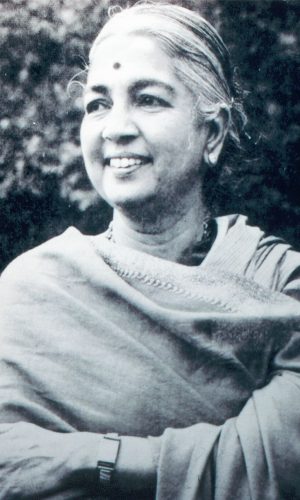
Born in 1904 in Madurai and raised within the spiritually vibrant environment of the Theosophical Society in Adyar, Rukmini Devi Arundale became one of the most transformative figures in the revival of Bharatanatyam. Guided by intuition, courage, and an unwavering aesthetic vision, she believed that art was a sacred force capable of restoring cultural dignity and spiritual depth.
A pivotal meeting with the legendary ballerina Anna Pavlova awakened in her a profound respect for dance as a serious classical art. Encouraged to rediscover the traditions of her own country, she began formal training in Bharatanatyam under the great guru Pandanallur Meenakshisundaram Pillai and was also initiated into the art by Mylapore Gowri Ammal. She broadened her theatrical understanding through exposure to Kathakali masters such as Ambu Panicker and Chandu Panicker.
At a time when social orthodoxy discouraged women of her background from learning temple dance traditions, she transcended convention with conviction and discipline. Her debut performance in 1935 marked a historic turning point. She re-envisioned Bharatanatyam for the modern proscenium stage—introducing dignified costuming inspired by temple sculpture, structured orchestra placement, minimalist backdrops, and refined stagecraft. Through these changes, she ushered the art into a new era of respect and renaissance.
From the outset, she understood the centrality of music to dance. Her deep commitment to artistic purity and sensitivity to nuance drew eminent musicians such as Tiger Varadachariar and his brother Krishnamachariar, Mysore Vasudevachariar, Budalur Krishnamurthy Sastri, Papanasam Sivan, and Veena Sambasiva Iyer into close collaboration. Under her guidance, music and dance were treated as inseparable disciplines, each elevating the other.
To ensure rigorous and holistic training, she founded Kalakshetra, an academy that would become synonymous with clarity of line, musical integrity, spiritual restraint, and uncompromising discipline. The institution attracted scholars, musicians, dancers, and thinkers who were drawn to her vision of art as a path of refinement and devotion.
Her artistic vision extended beyond performance into the revival of traditional crafts. With a discerning eye for proportion and color, she established a weaving center at Kalakshetra to restore South Indian handloom traditions. She revived natural dyes, classical motifs, and traditional weaving practices, ensuring that costumes worn on stage reflected the same aesthetic harmony as the dance itself. For her, textiles were an essential expression of cultural continuity and beauty.
Over her lifetime, she choreographed more than thirty dance-dramas, many of which continue to be performed with fidelity to her original vision. These productions brought epics and mythology to life with restraint, grace, and devotional intensity, creating what audiences often experienced as a temple-like atmosphere on stage.
Beyond the arts, she was a dedicated advocate for animal welfare and ethical living. As a member of the Rajya Sabha, she played a significant role in the passing of the Prevention of Cruelty to Animals Act and later served as Chairperson of the Animal Welfare Board of India. In 1977, when nominated for the Presidency of India, she declined, choosing instead to devote herself fully to her work at Kalakshetra.
Her legacy endures in the global flourishing of Bharatanatyam and in the refined aesthetic sensibility she championed—one rooted in discipline, compassion, beauty, and grace.
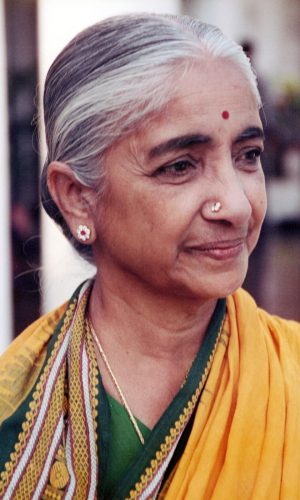
Sarada Hoffman, born in 1929 in Madras on the Adyar Theosophical Society campus, was a revered Bharatanatyam artiste and teacher known for her integrity, discipline, and precision. Though deeply respected as a guru, she never permitted the use of the title “Guru” before her name, preferring instead to be addressed simply and affectionately as “Sarada Teacher.”
During her years at Kalakshetra, resident students lovingly referred to her as “Chinna Sarada” to distinguish her from the senior scholar S. Sarada, her elder contemporary, who was also guiding students through a comprehensive education in natya.
Sarada Teacher was widely recognized for her uncompromising standards as both performer and pedagogue. She played a vital role in shaping and standardizing the Kalakshetra methodology of Bharatanatyam. Through her sustained efforts, along with those of her colleagues, the Kalakshetra style came to be regarded as one of the strongest foundational systems of Bharatanatyam, bringing clarity and cohesion to diverse traditional training practices and firmly establishing the Kalakshetra legacy.
She trained in Bharatanatyam at Kalakshetra under Rukmini Devi Arundale, Pandanallur Chokkalingam Pillai, and Gouri Amma. She also studied Kathakali under Gurus Ambu Panicker and Chandu Panicker. Upon completing her studies in 1947, she was appointed as a teacher and lead dancer at Kalakshetra.
Over more than five decades of dedicated service, Sarada Hoffman made enduring contributions to the field of dance. In her early years, she performed extensively with the Kalakshetra troupe before devoting herself primarily to teaching and composition in the Bharatanatyam tradition. She became a central pillar of Kalakshetra’s training program and was credited with preserving the institution’s distinctive technique and stylistic purity.
Many eminent dancers and teachers, including Yamini Krishnamurthy, Adyar Lakshman, C. V. Chandrasekhar, and V. P. Dhananjayan, benefited from her rigorous and refined training. After retiring as Head of the Dance Department in 1989, she continued to serve Kalakshetra as an Emeritus Faculty member until 1996.
In recognition of her exceptional contributions to Bharatanatyam, she received numerous honors, including the prestigious Sangeet Natak Akademi Award.
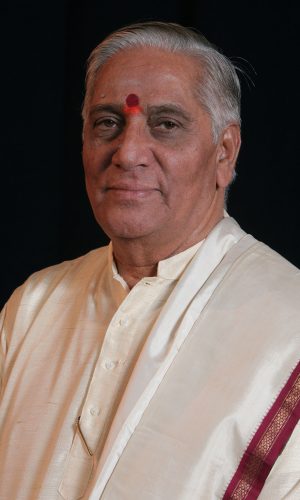
Sri Bhagavatalu Seetarama Sarma was a distinguished musician and composer of high repute in the field of Indian classical music. He was an “A” Grade artiste of All India Radio, Madras, in both classical and light classical music. As a concert musician and as the conductor of the Kalakshetra ballet troupe, he earned widespread acclaim from the press in India and abroad. His musical scores were highly celebrated for their depth, originality, and artistic excellence.
In 1961, he composed and produced the dance drama The Song of Harvest for the Summer Drama Festival in New Delhi. His 23 years of dedicated service at Kalakshetra marked a significant period of artistic achievement. During this time, he composed several major ballets for Smt. Rukmini Devi Arundale, including Meenakshi Kalyanam (Tamil), Ajamailopakyanam (Sanskrit), and Kurmavataram (Sanskrit). He also produced musical operas for All India Radio.
Several of his compositions, including Thiruneelakanta Nayanar and Bhagavad Gita, were presented as dance dramas. Sri Sarma also composed and choreographed RITU, which was performed by Kalapeetham students at I.T.I. Madras. In 1989, he collaborated in Paris with the world-renowned ballet choreographer Maurice Béjart in connection with the bicentennial celebrations of the French Revolution.
Sri Sarma successfully established the Kalapeetham School in India, the United States, and Singapore, nurturing generations of accomplished graduates in both music and dance.
In recognition of his immense contributions, he received the prestigious TTK Award from The Music Academy, Chennai, in 2007. He was also honored as an Asthana Vidwan of the Kanchi Kamakoti Peetam and received the Telugu Gaana Nrithya Rachana Kalavidha Rathna award from the Telugu Brahma Maha Sabha, Chennai. In his later years, he was conferred with the Ugadi Puraskar award.